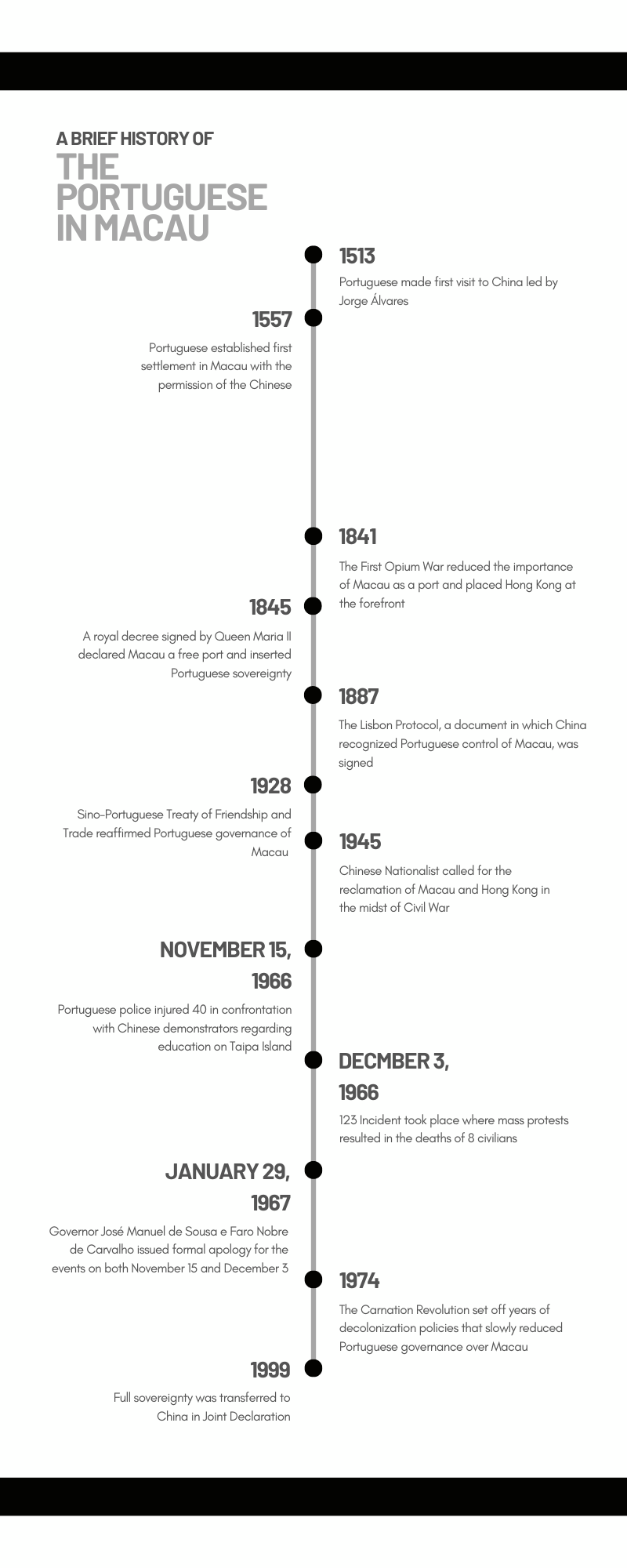
The Portuguese were present in Macau for more than 400 years. During the Age of Exploration, Portugal administered voyages to China as early as 1513. Over time, Macau, originally contained to the southern peninsula, would become an important trading port for Portuguese commerce. Throughout the 19th and 20th century, the Portuguese would gradually expand the borders of Macau to be the territory we recognize today. As Hong Kong gained more economic prominence in the world, Macau turned its focus to leisure and the city became a wealthy center for gambling and entertainment known by some as “The Beacon of the East.” During colonial rule, Lisbon was responsible for the policing system in Macau.
The Public Security Police (PSP) managed law and order, which was established in the Portuguese language, and was directed by the governor, while general members of the force were recruited from the local Chinese population (Ka-Ki Ho 2015, 86). Therefore, the Portuguese were in charge of leading responses to any civilian demonstrations such as the 123 Incident.

The short motion picture “Beacon of the East” was produced by Periscope Films and features Macau around the time of World War II, twenty years prior to the 123 Incident. It provides insight into the various industries within Macau such as fishing, agriculture, and commerce, while also highlighting its beauty. The film illustrates the mix of cultural influences present in Macau, as some areas resemble Chinese cities and others European rivieras.