Many attribute the cause of the 123 Incident to events that took place on Taipa Island a month prior. In 1966, worker unions proposed ideas for a left-leaning day school to be established. After several application attempts, the Portuguese government denied the permit for these unions to build a school in fear of China’s Cultural Revolution invading Macau. This caused unrest and distrust between civilians and the local government, sentiments that would culminate on November 15th.
Despite not having a permit, the workers’ union proceeded to renovate an old school building for the purpose of opening up a new educational institution on this date. The PSP ordered these renovations to stop, and was met with verbal opposition. The resistance later escalated and became physical, resulting in multiple injuries. The day after the confrontation, Taipa residents made several public demands, calling for authorities to be held accountable and for permission to build the school. These events heightened leftist rhetoric and fostered mass organization in the following weeks (Lam 2016).
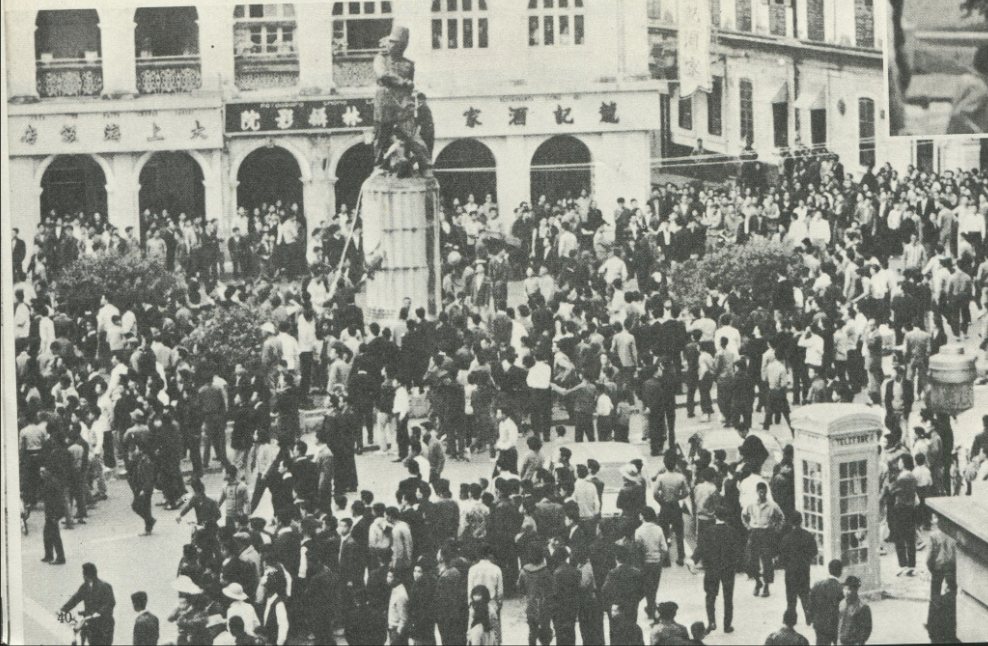
Anti-Portuguese sentiments among the Chinese community in Macau was the primary motivation for the demonstrations on December 3rd (Lam 2016, 172). Occupying the space in front of the governor’s house, student and teacher representatives protested Governor Carvalho’s refusal to meet with all the demonstrators. This resulted in a scuffle between authorities and civilians. Word of the violence spread quickly as more and more people joined the protest. The PSP used tanks, water cannons, and tear gas once the violence escalated. In response, protesters threw rocks and bricks at police. In the midst of the violence, the statue of Soon organization leader Ho Yin called for protesters to return home, most presumably at the will of the governor, urging “Everyone please remain calm” (Lam 2016, 174). Martial law was then enforced and within 24 hours, eight civilians were shot and killed by police, three of which in their own homes for simply looking out the window. Similar to Taipa, students made several explicit demands in the aftermath, asking the government to take responsibility for the violence that ensued.
Footage reveals that tensions remained high between the Portuguese and the Macau people in the days following December 3rd. The damages to the city that were made are a testament to the violence that took place. Police surveillance and military presence were increased to monitor the tension. Such aggression from the Portuguese would go on to be criticized by various parties.
